Affiliate disclosure: some links in this article are affiliate links. If you sign up through them I may earn a commission at no extra cost to you. Prices below were checked in August 2026 — always confirm on the official pricing page, because they change.
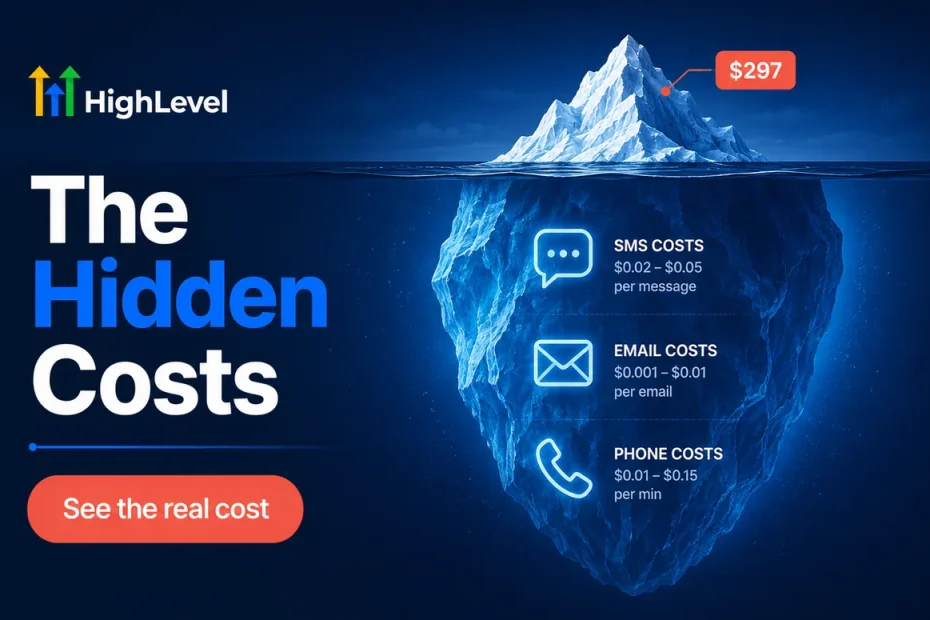
Short answer: your GoHighLevel subscription does not include usage. The $97, $297 or $497 you pay every month buys you the software. Every text message, every email, every phone number and every AI reply is billed separately from a wallet you top up. For a small agency that usually means $30–$80 per month on top of the plan; for a busy one running SMS campaigns it can pass $300.
This is the single most common complaint in r/gohighlevel — not that the platform is bad, but that the first invoice was bigger than expected. Below is every line item, what it costs in 2026, and how to estimate your own number before you commit.
Why the plan price is not the real price
GoHighLevel resells communications infrastructure. Texts and calls run through Twilio, emails through Mailgun, and GoHighLevel wraps both under its own brand called LeadConnector. You are billed at LeadConnector rates, which sit slightly above raw carrier cost — that margin is part of how the platform makes money.
Practically, this means your account has two separate charges each month:
- The subscription — fixed, charged to your card on your renewal date.
- The usage wallet — variable, auto-recharged in fixed increments (commonly $10 or $20) every time the balance drops below your threshold.
The wallet is what surprises people. If you set a $10 auto-recharge and send a large campaign, you can trigger the recharge a dozen times in one afternoon and see a dozen separate charges on your statement.
Test the real costs before you commit
The only way to see your exact rates is inside the account — Settings > Company Billing shows the per-message price for your country. The extended trial gives you 30 days to check it with zero risk.
SMS and MMS pricing in 2026
SMS is billed per segment, not per message. A segment is 160 characters of plain GSM text. Add an emoji, a curly apostrophe or an accented character and the whole message switches to Unicode encoding, where a segment is only 70 characters. That single detail is why so many people report costs double what they estimated.
| Item | Base rate (US) | What you actually pay | Notes |
|---|---|---|---|
| Outbound SMS segment | $0.0079 | $0.013 – $0.018 | Carrier surcharges are added on top of the base rate |
| Inbound SMS segment | $0.0079 | ~$0.010 | Replies cost you money too |
| MMS (picture message) | ~$0.020 | $0.025 – $0.035 | Roughly 2–3× an SMS segment |
| Phone number (local) | $1.15 / month | $1.15 / month | Per number, per sub-account |
| Toll-free number | ~$2.15 / month | ~$2.15 / month | Needs its own verification |
A realistic SMS example
Say you run a reactivation campaign for one client: 1,000 contacts, a 190-character message (2 segments because it exceeds 160), and a 12% reply rate.
- Outbound: 1,000 × 2 segments × $0.015 = $30.00
- Inbound replies: 120 × 1 segment × $0.010 = $1.20
- Total for one campaign: about $31
Run that weekly for four clients and you are at roughly $500/month in SMS alone. That is not a hidden fee — it is the cost of the channel — but it has to be in your pricing or it comes straight out of your margin. This is exactly the maths covered in how many clients you need to break even.
A2P 10DLC registration: the mandatory US fee
If you send SMS to US numbers you must register your traffic under A2P 10DLC. This is a carrier requirement, not a GoHighLevel one, and it is unavoidable. Unregistered traffic gets filtered or blocked outright.
| Fee | Cost | Frequency |
|---|---|---|
| Brand registration | ~$4 | One time, per brand |
| Campaign registration | $10 – $19 | One time, per campaign |
| Campaign maintenance | $2 – $10 / month | Ongoing, per campaign |
| Sole proprietor verification | ~$4 + $1.50/mo | If you register as an individual |
The trap for agencies: every client sub-account that sends SMS needs its own registration. Ten clients means ten campaign registrations and ten monthly maintenance fees — call it $40–$100/month just to keep the pipes open, before a single message is sent.
Email costs
Email is the cheapest channel by a wide margin and rarely the thing that blows up an invoice.
| Item | Rate | What that means in practice |
|---|---|---|
| Outbound email | ~$0.675 per 1,000 | 10,000 emails/month ≈ $6.75 |
| Dedicated IP | Optional add-on | Only worth it above roughly 100k sends/month |
| Email validation | ~$0.0025 per contact | Optional but recommended before big sends |
For context: sending 50,000 emails a month costs about $34. The same volume on a standalone platform like ActiveCampaign or Klaviyo would typically run $150–$400 depending on list size. Email is where GoHighLevel genuinely undercuts the alternatives.
See your own rate card
Rates differ by country and by how your account is provisioned. Inside the platform, Settings > Company Billing shows your exact per-segment and per-email price — no guesswork.
Voice and phone system costs
| Item | Rate | Notes |
|---|---|---|
| Inbound call | $0.0085 / min | Charged while the call is connected |
| Outbound call | $0.014 / min | Higher than inbound |
| Call recording | Small per-minute add-on | Storage is billed separately over time |
| Voicemail drop | Billed as outbound minutes | Cheap per drop but adds up on large lists |
A call-heavy operation is where voice stops being trivial. 2,000 outbound minutes a month is $28 — manageable. A dialer team burning 20,000 minutes is $280/month, which needs to be a line in your budget.
AI features: the newest and fastest-growing line item
This is the category that has grown most since 2024 and the one most likely to produce a surprise invoice, because AI usage scales with conversation volume rather than with your effort.
| Feature | Rate | What triggers a charge |
|---|---|---|
| Conversation AI | $0.02 per message | Every AI-generated reply in a chat or SMS thread |
| Voice AI | ~$0.163 per minute | Time the AI agent spends on a live call |
| Reviews AI | $0.08 per review | Each AI-written review response |
| Content AI | Per generation | Copy and image generation inside the builders |
Do the arithmetic before you switch Voice AI on. An AI receptionist handling 300 calls a month at an average of 3 minutes is 900 minutes × $0.163 = about $147/month. That may be a bargain against a human receptionist, or it may be more than your client pays you. Either way, know the number first.
The costs nobody puts in a table
Two more things belong in an honest accounting, even though they never appear on an invoice.
Setup time
Budget 20–40 hours to get genuinely fluent with GoHighLevel if you are coming from a simpler tool. The builder, the workflow engine and the permissions model each have their own logic. At an opportunity cost of $75/hour that is $1,500–$3,000 of your time in month one — usually the largest single cost of year one, and the one people leave out.
Add-ons you will probably want
- White label mobile app — separate setup and monthly fee. Full breakdown in the white label app cost article.
- HIPAA compliance — a paid add-on, mandatory if you handle health data (see the med spa guide).
- Premium workflow actions — certain triggers and actions carry a per-execution charge.
- Third-party snapshots — a one-time $200–$2,000 depending on the vendor.
Putting it together: three realistic monthly bills
| Profile | Plan | Usage | Realistic total |
|---|---|---|---|
| Solo consultant, 1 sub-account, light SMS | $97 | $25 – $40 | $122 – $137 |
| Small agency, 5 clients, moderate SMS + email | $297 | $120 – $250 | $417 – $547 |
| SaaS agency, 15 clients, SMS campaigns + Voice AI | $497 | $400 – $900 | $897 – $1,397 |
The good news for the third profile: on SaaS Pro you can rebill that usage to clients with your own markup, which turns the cost line into a revenue line. That is the whole argument of the SaaS Pro review and the mechanics are in the rebilling setup guide.
How to keep the bill under control
- Set the auto-recharge deliberately. Too low and you get a wall of small charges; too high and a runaway workflow drains real money. $50 with a $50 threshold is a sane starting point.
- Write in plain GSM characters. Avoid emoji and curly quotes in SMS templates — it halves your segment size and can double your cost.
- Validate lists before big sends. A quarter of a cent per contact beats paying to text dead numbers.
- Cap AI conversations. Set a message limit per thread so a looping conversation cannot bill indefinitely.
- Check usage weekly for the first month. Billing > Usage shows the breakdown by sub-account, which is how you find the one client whose workflow is misfiring.
When GoHighLevel is not the cheaper option
Being straight about this: if you are a solo operator who sends almost no SMS, runs one funnel and emails a list of 500 people, GoHighLevel is more expensive than a $29 email tool plus a free funnel builder. The platform earns its price when you are consolidating four or five subscriptions or reselling to clients. If you are not doing either, the $97 plan is likely more software than you need.
The full year-one comparison against a separate tool stack is in GoHighLevel vs building your own stack, and the complete 12-month number is in the total cost of ownership breakdown.
Frequently asked questions
Does GoHighLevel include free SMS credits?
New accounts typically get a small starting credit, but it is a trial courtesy rather than a monthly allowance. Plan on paying for usage from day one.
Can I use my own Twilio account instead?
Yes. You can connect your own Twilio and Mailgun accounts and pay those vendors directly, which removes the LeadConnector margin. You lose the consolidated billing and, on SaaS Pro, the ability to rebill usage to clients at a markup — so it mainly makes sense for high-volume senders who are not reselling.
What happens if my wallet hits zero?
Messages stop sending. Workflows that depend on SMS or email will stall rather than queue indefinitely, which is why the auto-recharge threshold matters more than it looks.
Run the numbers on your own account
Thirty days is enough to send real campaigns, watch the usage wallet move and know your true monthly cost before you are committed to anything.