Affiliate disclosure: some links in this article are affiliate links. If you sign up through them I may earn a commission at no extra cost to you. Prices below were checked in August 2026 — always confirm on the official pricing page, because they change.
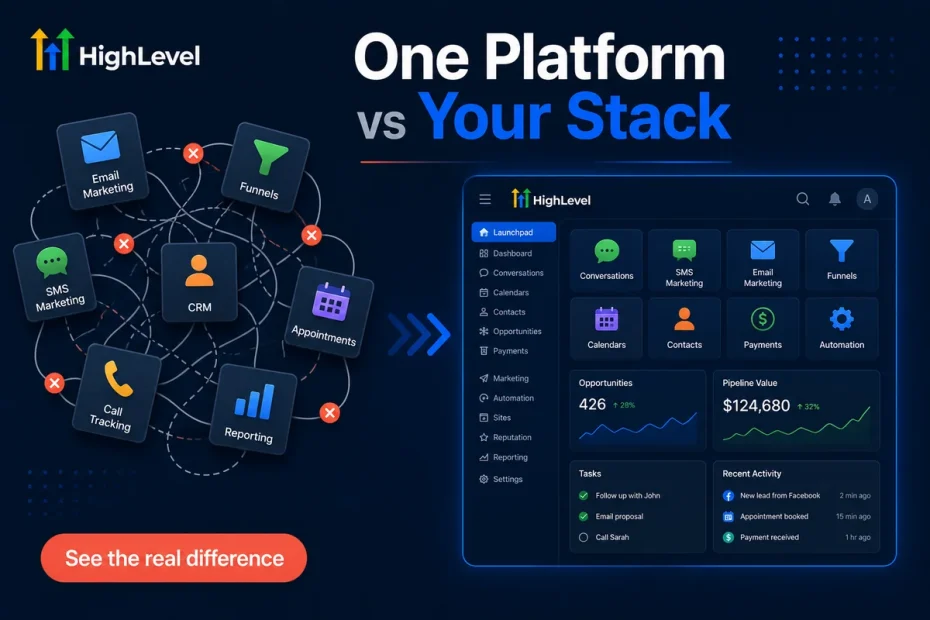
Short answer: a comparable best-of-breed stack runs $368–$1,157 a month at list prices. GoHighLevel Unlimited runs about $500 all-in. On pure subscription cost it is close. GoHighLevel wins decisively on two things the spreadsheet misses: the integration tax, and the fact that you can resell it. The separate stack wins when you need one function done exceptionally well.
I run GoHighLevel and I earn a commission if you sign up through this page, so read the ‘when the separate stack wins’ section carefully — it is the honest part.
What you are actually comparing
An agency needs roughly eight capabilities. Here is what each costs standalone versus bundled.
| Capability | Best-of-breed tool | Monthly | In GoHighLevel? |
|---|---|---|---|
| CRM and pipelines | Pipedrive / HubSpot Starter | $20 – $100 | Included |
| Email marketing | ActiveCampaign / Klaviyo | $70 – $250 | Included (usage billed) |
| Funnels and landing pages | ClickFunnels / Unbounce | $97 – $297 | Included |
| Scheduling | Calendly Teams | $16 – $50 | Included |
| SMS | Twilio direct | $60 – $150 | Included (usage billed) |
| Forms and surveys | Typeform / Jotform | $25 – $60 | Included |
| Reputation and reviews | Birdeye / Podium (light tier) | $50 – $150 | Included |
| Automation glue | Zapier / Make | $30 – $100 | Native workflows |
| Total | — | $368 – $1,157 | ~$500 all-in |
At the bottom of the range the separate stack is cheaper. At the top it is more than double. Where you land depends almost entirely on your email list size, because that is what drives ActiveCampaign and Klaviyo pricing into the stratosphere.
Compare it against your own stack
Add up what you pay today, then run GoHighLevel free for 30 days alongside it. That is a real comparison rather than a table of list prices.
The integration tax
This is the cost that never makes it into the comparison and usually decides the outcome.
Zapier operations add up faster than you think
A single lead moving through a separate stack might fire six Zaps: form to CRM, CRM to email tool, booking to CRM, booking to SMS reminder, no-show to follow-up sequence, closed-won to onboarding. At 1,000 leads a month that is 6,000 operations — comfortably into Zapier’s $100+ tiers, and that is before anything breaks.
Debugging time is real money
When a lead does not arrive, you have to work out which of eight systems dropped it. In a bundled platform the data never left the building. Agencies I have compared notes with put this at two to five hours a month once they are running several clients — call it $150–$375 in billable time you are not billing.
Client-facing complexity
Eight tools means eight logins to explain, eight places a client can see something confusing, and eight vendors whose price increases you absorb. It also means you cannot hand a client a single branded app, which is a real differentiator when you are selling.
Add it up and the integration tax is plausibly $200–$500 a month in tooling and unbilled time. That is what tips a close subscription comparison decisively.
The thing that actually decides it: can you resell it?
This is the asymmetry that no feature table captures. You cannot resell ActiveCampaign. You can resell GoHighLevel.
On SaaS Pro you create sub-accounts, brand them as your own product, set your own price and bill your clients directly. Fifteen clients at $297 is $53,460 a year of recurring revenue against a $4,970 subscription. No best-of-breed stack offers anything comparable — you would be reselling someone else’s login, which their terms forbid.
If you have no intention of reselling, this argument does not apply to you and the comparison stays close. If you do, it is not close at all. The mechanics are in the SaaS Mode guide and the margin maths in the SaaS Pro review.
When the separate stack genuinely wins
Four situations, and I would not argue with you on any of them.
1. You need depth in one function
Klaviyo’s e-commerce flows, its predictive segmentation and its Shopify integration are better than GoHighLevel’s email. If email revenue for e-commerce clients is your core service, use Klaviyo. GoHighLevel’s email is good enough for lead nurture; it is not a specialist e-commerce tool.
2. Your list is small and your sending is light
If you email 500 people once a month and never send SMS, a $29 email tool and a free page builder beats $97. The bundle earns its price through consolidation — with nothing to consolidate, you are paying for capability you will not use.
3. You have deep existing investment
Three years of HubSpot workflows, custom objects and reporting your team knows cold has real switching cost. Migration is not free — budget 40–90 hours. Sometimes the right answer is to keep what works.
4. You need something GoHighLevel does not do
Complex inventory, multi-currency e-commerce, deep accounting integration, sophisticated attribution modelling. GoHighLevel is broad rather than deep; if your requirement sits outside that breadth, no amount of cost saving fixes it.
Run both for a month and decide with data
Thirty days free is enough to rebuild one client’s setup inside GoHighLevel and compare it honestly against what you run today.
The honest downsides of consolidating
Two that matter, stated plainly.
Single point of failure
When GoHighLevel has an outage, everything stops — CRM, email, SMS, booking, all of it. With a separate stack an outage at one vendor is an inconvenience. This is a genuine risk and the correct mitigation is regular contact exports, not pretending it does not exist.
Vendor lock-in
Funnels, workflows and snapshots do not export to anything else in usable form. Contacts export fine; the two hundred hours you spent building automations do not. After a year of building, leaving is expensive in a way that leaving Calendly is not.
Both are real. Neither is a reason not to use it — they are reasons to go in with your eyes open and an export routine.
A decision framework
| If you are… | Choose | Why |
|---|---|---|
| An agency with 3+ clients wanting to resell | GoHighLevel SaaS Pro | Reselling changes the entire equation |
| An agency with 3–10 clients, not reselling | GoHighLevel Unlimited | Consolidation plus the integration tax |
| A solo consultant with 1–2 clients | Either — run the numbers | Close call; depends on your channel mix |
| An e-commerce specialist | Separate stack with Klaviyo | Depth beats breadth in this niche |
| Heavily invested in HubSpot | Stay, or migrate deliberately | Switching cost may exceed the saving |
| Just starting, no clients yet | Start free, decide in 30 days | Do not pay for either until you have revenue |
Frequently asked questions
Can I run both during a transition?
Yes, and you should. Move one client over first, run it in parallel for a month, then migrate the rest. The overlap costs you one extra subscription and saves you from discovering a gap after you have cancelled everything.
Is GoHighLevel’s email deliverability as good as a dedicated tool?
For lead nurture and transactional sends, yes — it runs on Mailgun infrastructure. For large cold-ish campaigns you will want a dedicated IP and proper warm-up, same as anywhere else. Specialist tools give you more control over the details.
What about Make or n8n instead of Zapier?
They are cheaper per operation and worth considering if you stay on a separate stack. They do not remove the integration tax — they lower one component of it. You still own the debugging.
The bottom line
On subscription alone it is closer than the marketing on either side suggests. Add the integration tax and GoHighLevel pulls ahead for most agencies. Add reselling and it is not a contest — but only if you actually intend to resell.
If you are an e-commerce email specialist, keep your specialist tools. If you are a general agency juggling six subscriptions and a Zapier bill, the consolidation case is strong. The full year-one numbers for both paths are in the total cost of ownership breakdown.
Test the consolidation case yourself
Rebuild one client inside GoHighLevel during the free trial. If it holds up, the rest of the comparison answers itself.