Affiliate disclosure: some links in this article are affiliate links. If you sign up through them I may earn a commission at no extra cost to you. Prices below were checked in August 2026 — always confirm on the official pricing page, because they change.
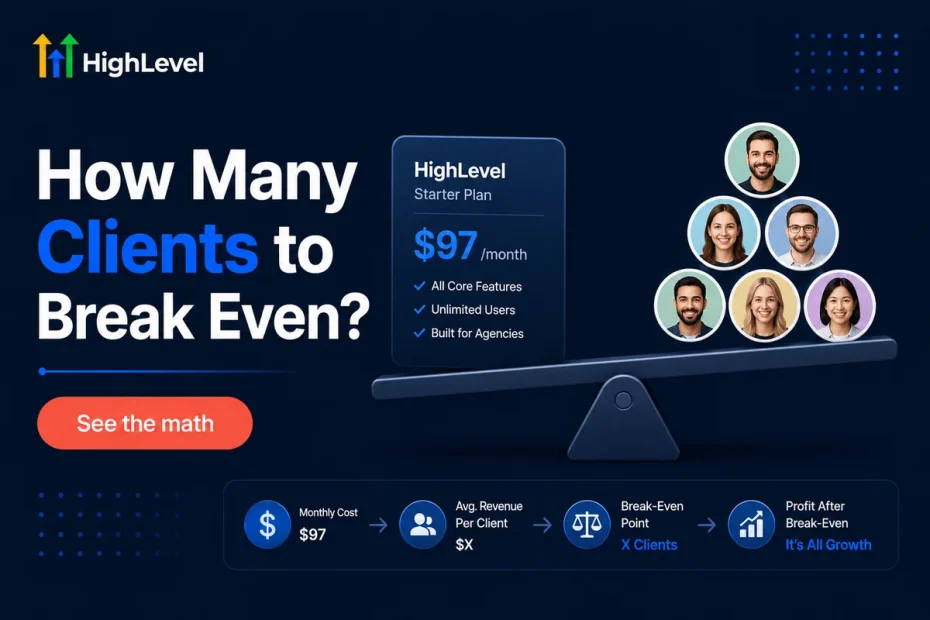
Short answer: one client on Starter, one on Unlimited, and two on SaaS Pro — if you charge $297 a month. Include usage costs and the honest numbers are one, two and two. Turn on rebilling and SaaS Pro drops back toward one and a half, because your clients start covering the variable costs.
Most break-even calculations you will find divide the plan price by your retainer and stop there. That understates it, because the plan is not your only cost. Here is the version that includes everything.
The naive calculation (and why it is wrong)
| Plan | Monthly | Clients at $297 to break even | Clients at $1,500 retainer |
|---|---|---|---|
| Starter | $97 | 1 | 1 |
| Unlimited | $297 | 1 | 1 |
| SaaS Pro | $497 | 2 | 1 |
It is wrong because usage is billed separately. Every SMS, email, phone number and AI reply comes out of a wallet on top of the subscription. Ignoring that is how people conclude the platform is cheaper than it turns out to be — the full detail is in the hidden costs breakdown.
The honest calculation
| Plan | Subscription | Realistic usage | True monthly cost | Clients at $297 | Clients at $1,500 |
|---|---|---|---|---|---|
| Starter | $97 | $25 – $40 | ~$130 | 1 | 1 |
| Unlimited | $297 | $120 – $250 | ~$480 | 2 | 1 |
| SaaS Pro | $497 | $400 – $900 | ~$1,150 | 4 | 1 |
The SaaS Pro row looks alarming until you notice what is missing: on SaaS Pro you are not absorbing that usage, you are rebilling it.
Find your own break-even in 30 days
A month of real usage tells you your actual variable cost, which is the only number that makes this calculation meaningful.
What rebilling changes
On SaaS Pro you set a markup on usage and your clients pay for their own messages. If you mark up 100%, each client’s SMS spend becomes a small profit centre rather than a cost.
| Scenario | Your cost | Client pays | Net to you |
|---|---|---|---|
| No rebilling — 5 clients, $600 total usage | $600 | $0 | −$600 |
| Rebilling at cost — same usage | $600 | $600 | $0 |
| Rebilling at 100% markup | $600 | $1,200 | +$600 |
With rebilling at a modest markup, your true SaaS Pro cost falls back toward the $497 subscription, and break-even at $297 per client returns to two clients. That is the whole argument for the top plan, and it is examined properly in the SaaS Pro review.
Break-even by business model
If you resell sub-accounts at $297
| Plan | Break-even | At 5 clients | At 10 clients | At 20 clients |
|---|---|---|---|---|
| Starter (3 sub-accounts max) | 1 client | Not possible — 3 sub-account limit | — | — |
| Unlimited | 2 clients | +$1,005/mo | +$2,490/mo | +$5,460/mo |
| SaaS Pro (with rebilling) | 2 clients | +$988/mo | +$2,473/mo | +$5,443/mo |
Notice that Unlimited and SaaS Pro produce almost identical profit at these volumes. The difference is that SaaS Pro automates the billing, the sign-up and the rebilling — you are paying $200 a month for the machinery, not for extra margin. The plan comparison is in Unlimited vs SaaS Pro.
If you use it to service clients (not resell)
Here the break-even is not about client count at all — it is about what you were paying before. If GoHighLevel replaces $400 a month of separate subscriptions, it breaks even on day one regardless of how many clients you have. That comparison is in GoHighLevel vs a custom stack.
If you are solo with one or two clients
Starter at roughly $130 all-in against a single $1,500 retainer is 8.7% of revenue — a normal software cost. Against a single $500 client it is 26%, which is high but arguably still worth it if it saves you five hours a month.
Test the model before you commit
Thirty days free is enough to onboard a real client and see whether the arithmetic works in your business.
The calculation nobody does: your time
Break-even in dollars is the easy half. The harder question is whether the platform saves you enough hours to justify the setup.
Budget 25–40 hours to get properly fluent. At a $75 opportunity cost that is $1,875–$3,000 in month one — far more than the subscription. So the real question is: does it save you more than 30 hours over the first year?
For an agency running manual follow-up across five clients, it saves that in the first two months. For a solo consultant with one client and a simple process, it may never pay back the setup time. Be honest about which one you are.
A quick self-test
Answer these four:
- How many clients will be on the platform in 90 days? (If the answer is zero, wait.)
- What are you paying today for tools GoHighLevel would replace?
- Will you resell sub-accounts, or only service clients? (This decides Unlimited versus SaaS Pro.)
- Can you commit 25–40 hours to setup in the first two months?
If you have at least one paying client, over $200 a month in tools being replaced, and the time to invest — the arithmetic works comfortably. If you have no clients yet, the honest answer is that no plan breaks even, because zero times any retainer is zero. Get the client first.
Frequently asked questions
What if I charge less than $297 per client?
Divide your true monthly cost by your price. At $150 per client, Unlimited at $480 all-in needs four clients rather than two. The method is the same; only the divisor changes.
Should I start on Starter and upgrade?
Usually yes, unless you already know you will exceed three sub-accounts quickly. Upgrading is straightforward; the three sub-account ceiling is the practical trigger, explained in the Starter sub-account article.
Does annual billing change the break-even?
It lowers it by about 17% on the subscription portion. On SaaS Pro that is roughly $83 a month, which shifts break-even from two clients to about one and a half. See the annual billing breakdown.
The bottom line
One client covers Starter. Two cover Unlimited or SaaS Pro once you include usage. With rebilling on SaaS Pro, two clients cover everything and the third onward is close to pure margin.
The number that should actually decide it is not the break-even at all — it is whether you have clients. With three, every plan is comfortably profitable. With none, the cheapest plan is still infinitely expensive.
Start free and do the maths on real data
Thirty days on a live account, with your own usage numbers, beats any estimate in this article.