Affiliate disclosure: some links in this article are affiliate links. If you sign up through them I may earn a commission at no extra cost to you. Prices below were checked in August 2026 — always confirm on the official pricing page, because they change.
Short answer: GoHighLevel works well for real estate because the business is speed-to-lead plus very long nurture — exactly what the platform is built for. A solo agent runs it on Starter at roughly $130–$160 a month all-in. A team of five needs Unlimited at $400–$550. The single highest-value thing you will build is a sub-five-minute response automation.
What it is not is an MLS-integrated transaction platform. It will not replace your brokerage’s compliance system or your MLS. It replaces your CRM, your email tool, your text follow-up and your booking link.
Why real estate fits the platform
Three characteristics of the business line up unusually well:
- Speed matters more than anything. Lead response research has been consistent for two decades: contact within five minutes and your qualification odds improve dramatically. Automation is how you hit that at 9pm on a Sunday.
- The sales cycle is long and uneven. A seller lead might convert in three weeks or eighteen months. Manual follow-up fails at that horizon; workflows do not forget.
- Referrals and repeat business are most of your income. Which means a past-client nurture campaign running quietly in the background is worth more than any new lead source.
Build a real estate setup free for 30 days
Long enough to import your database, build both pipelines and have the speed-to-lead automation running before you pay anything.
The two pipelines you need
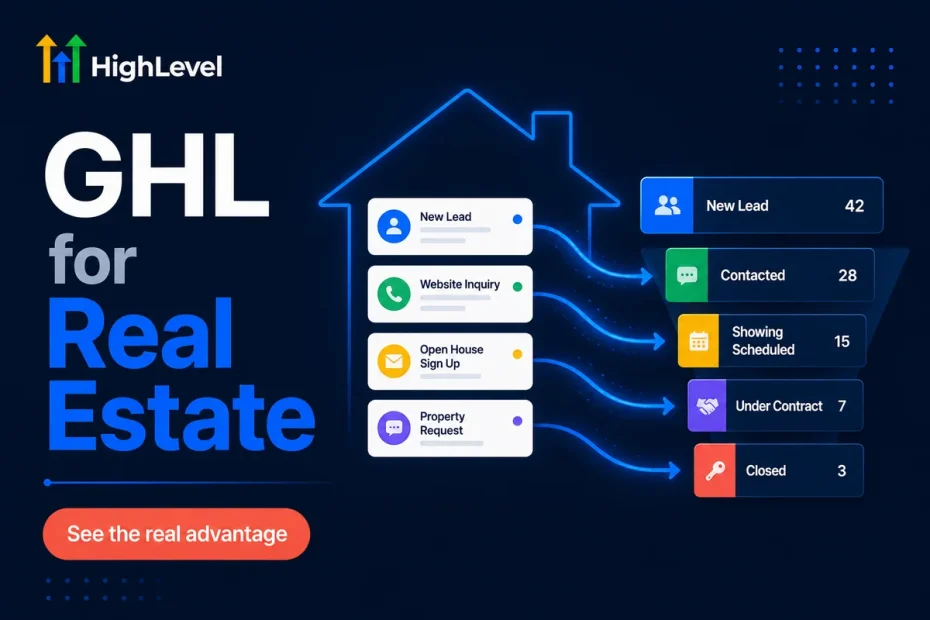
Do not run one pipeline for everything. Buyers and sellers have different stages, different timelines and different questions.
Buyer pipeline
| Stage | What it means | Automation to attach |
|---|---|---|
| New lead | Enquiry received | Instant SMS + email, task to call within 5 min |
| Contacted | You have spoken to them | Buyer consultation booking link |
| Pre-approval | Sent to lender | Reminder sequence until approval is confirmed |
| Actively viewing | Touring properties | New listing alerts matching criteria |
| Offer submitted | Under negotiation | Status updates every 48 hours |
| Under contract | Accepted | Milestone checklist: inspection, appraisal, closing |
| Closed | Done | Move to past-client nurture |
Seller pipeline
| Stage | What it means | Automation to attach |
|---|---|---|
| Valuation request | Home value enquiry | Instant automated estimate + booking link |
| Appointment set | Listing presentation booked | Confirmation, reminders, pre-appointment info pack |
| Presentation given | You have pitched | Follow-up sequence over 7 days |
| Listed | On market | Weekly seller update: views, feedback, activity |
| Under contract | Offer accepted | Milestone checklist |
| Closed | Sold | Review request, then past-client nurture |
The speed-to-lead automation
If you build one thing, build this. It is roughly forty minutes of work and it is the difference between converting your leads and paying for someone else to convert them.
- Trigger: new contact created with source = your lead form or portal integration.
- Immediately: send an SMS. Short, human, from your number — ‘Hi {{first_name}}, this is Sarah with {{company}}. Saw your enquiry on 42 Oak St — are you free for a quick call today?’
- Simultaneously: send an email with the property details and your booking link.
- Immediately: create a task for yourself with a five-minute due time and push a notification to your phone.
- Wait 15 minutes. If no reply, second SMS with a different angle.
- Wait 2 hours. If still nothing, move into the long nurture sequence rather than continuing to chase.
Keep the first SMS in plain characters and under 160. Emoji push it into Unicode encoding and halve your segment size, which doubles the cost of your highest-volume message — the details are in the hidden costs breakdown.
The long nurture that most agents skip
A lead who is ‘not ready for twelve months’ is not a dead lead, it is a lead with a date. Build a twelve-month sequence and let it run:
- Monthly: a genuine market update for their area — median price, days on market, inventory. Not a listing dump.
- Quarterly: something useful and non-commercial. Property tax deadlines, a seasonal maintenance checklist, school catchment changes.
- Annually: home anniversary message for past clients, with a current valuation.
- Triggered: when a comparable property in their area sells, send it.
At roughly $0.0007 per email, nurturing 2,000 past contacts monthly costs about $1.35. That is the cheapest revenue in real estate and almost nobody does it consistently, because doing it manually is impossible.
Set up your nurture during the trial
Import your past-client database, build the twelve-month sequence, and let it run. Thirty days free is plenty.
What it costs
| Setup | Plan | Typical usage | Monthly total |
|---|---|---|---|
| Solo agent, ~500 contacts | Starter $97 | $30 – $60 | $127 – $157 |
| Small team of 3–5 | Unlimited $297 | $100 – $250 | $397 – $547 |
| Team of 10+ with ISA | Unlimited $297 | $300 – $600 | $597 – $897 |
For perspective: one additional closed transaction at a $8,000 commission covers a solo agent’s platform cost for roughly four years. The break-even arithmetic across plans is in the break-even article.
A team of five on Starter will hit the three sub-account limit quickly — though note that for a single brokerage you typically want one sub-account with multiple users rather than a sub-account per agent.
Integrations that matter
- Zillow, Realtor.com and portal leads — route them in by email parser or webhook so they hit your speed-to-lead workflow like any other source.
- Facebook lead ads — native integration, and this is where instant response pays off most.
- Google Business Profile — connect it for review requests after closing.
- Your MLS — generally no direct integration. Most agents run listing alerts through their MLS portal and use GoHighLevel for everything relationship-side.
Where GoHighLevel falls short for real estate
Being straight about the gaps:
- No MLS integration. Purpose-built real estate CRMs like Follow Up Boss have deeper portal connections. If automated MLS-driven listing alerts are central to your model, that is a genuine limitation.
- No transaction management. It will not handle compliance documents or brokerage workflows.
- No IDX search. You still need a separate IDX solution for property search on your site.
- Setup is on you. Real estate snapshots help, but expect 10–20 hours to get a good configuration running.
The trade is breadth for depth. You give up specialist real estate features and gain a platform that also runs your email, texting, booking, reputation and — if you want — lets you resell the whole thing to other agents in your market.
Frequently asked questions
Is there a ready-made real estate snapshot?
Yes, several in the marketplace and from third-party vendors, typically $200–$2,000. They save time but you will still customise heavily. My advice is to build your main pipeline manually first — you will understand the platform far better and know what you are actually buying.
Can each agent on my team have their own pipeline?
Yes. Within one sub-account you assign contacts and opportunities to individual users, each with their own view. You do not need a sub-account per agent.
Does it work outside the US?
Yes, though SMS rates and compliance requirements differ by country, and A2P 10DLC registration is a US requirement specifically. Check the rate card for your market.
Try it on your own database
Import your contacts, build the buyer and seller pipelines and run the speed-to-lead automation for a month before deciding.