Affiliate disclosure: some links in this article are affiliate links. If you sign up through them I may earn a commission at no extra cost to you. Prices below were checked in August 2026 — always confirm on the official pricing page, because they change.
Short answer: solar is a long, multi-stage, document-heavy sale where leads go cold in minutes and deals die in the middle. GoHighLevel handles the two things that actually lose solar deals: slow first response, and the silent gap between signed contract and installation. A regional installer runs it on Unlimited at roughly $400–$700 a month.
Solar is unusual in that the lead is expensive — often $50–$300 depending on the channel — and the cycle is long. Both facts mean automation is worth far more here than in a typical local services business.
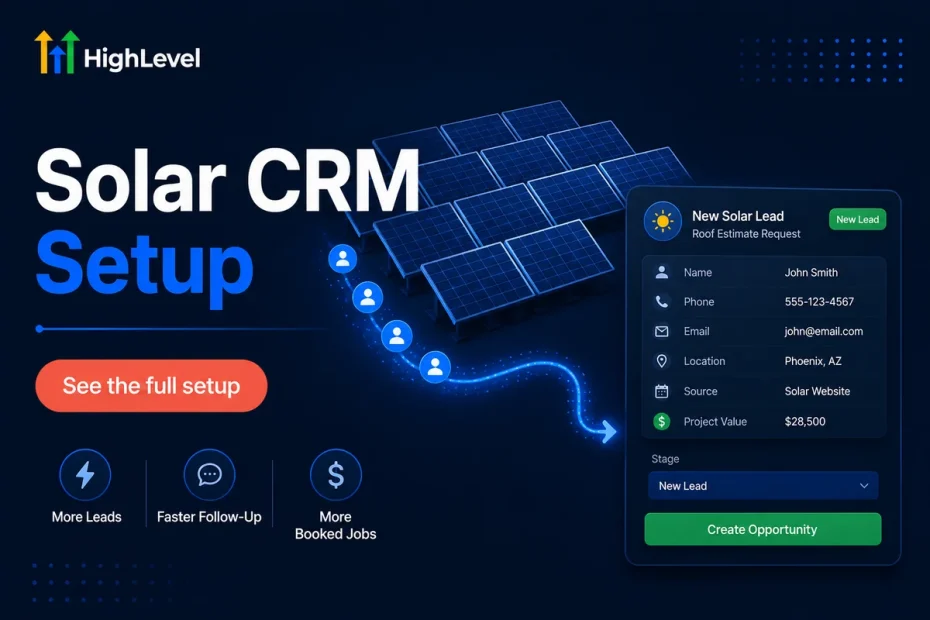
The seven-stage solar pipeline
| Stage | Typical duration | Where deals die | Automation |
|---|---|---|---|
| New lead | Minutes | Slow response — the biggest single killer | Instant SMS + call task within 5 min |
| Qualified | 1 – 3 days | Bad fit discovered late | Qualification form: ownership, bill, roof, credit |
| Site survey booked | 3 – 10 days | No-shows | Reminder sequence at 48h and 3h |
| Proposal sent | 5 – 14 days | Silence after the proposal | Structured follow-up every 2–3 days |
| Contract signed | 1 – 7 days | Cold feet during cooling-off | Reassurance sequence, not silence |
| Permitting and install | 30 – 90 days | Cancellations from lack of updates | Automated milestone updates |
| PTO and complete | 7 – 30 days | — | Review request, then referral campaign |
Look at stage six. Thirty to ninety days of permitting, inspection and utility interconnection during which the customer hears nothing and starts wondering whether they made a mistake. This is where signed deals cancel, and it is entirely fixable with automation.
Build the pipeline free for 30 days
Long enough to configure all seven stages, wire up the speed-to-lead automation and run real leads through it.
Speed to lead: the number that decides your close rate
Solar leads are frequently shopped across three or four installers. The one who responds first has an enormous advantage — not because they are better, but because they are first.
Build this on day one:
- Trigger: new lead from any source — form, Facebook lead ad, purchased lead feed, call tracking.
- Within seconds: SMS from a local number. ‘Hi {{first_name}}, this is Mike at {{company}} — got your solar enquiry. Quick question: do you own the home?’ A question gets a reply; a statement does not.
- Within seconds: email with a short explainer and your booking link.
- Immediately: task assigned to the rep on rotation, due in five minutes, with a phone push.
- 15 minutes, no reply: second SMS from a different angle — average bill or savings estimate.
- 1 hour, no reply: automated call attempt or a voicemail drop.
- Day 2 onward: drop into a 30-day nurture rather than continuing to chase daily.
If you buy leads, this workflow is the difference between a viable cost per acquisition and setting money on fire. A $200 lead that never gets a response is a $200 loss.
Qualification: stop wasting site surveys
A truck roll for an unqualified lead costs real money. Four questions eliminate most bad fits before anyone drives anywhere:
- Do you own the home? Renters cannot proceed. This alone removes a large share of enquiries.
- What is your average monthly electricity bill? Below a threshold the economics do not work.
- How old is your roof? A roof needing replacement in two years changes the entire conversation.
- Are you comfortable with a credit check? Financing is how most residential solar closes.
Build these into the intake form and use workflow conditions to route automatically: qualified leads book a survey, unqualified ones go into a long nurture with an explanation. Nobody gets ignored, and nobody wastes a survey slot.
The installation-window update sequence
This is the highest-value automation in solar and almost nobody builds it. The customer has signed and now waits two to three months. Silence breeds doubt; doubt breeds cancellation.
| Milestone | Message | Channel |
|---|---|---|
| Contract signed | Welcome, what happens next, realistic timeline | Email + SMS |
| Site survey complete | Design in progress, expected date | SMS |
| Design approved | Here is your system layout | Email with the design |
| Permit submitted | Submitted to the city, typical wait time | SMS |
| Permit approved | Approved — scheduling installation | SMS |
| Install scheduled | Date confirmed, how to prepare | Email + SMS + calendar invite |
| Install complete | Done — next step is utility approval | SMS |
| PTO granted | System is live. Here is how to monitor it | Email + SMS |
| Day 30 post-PTO | Production check-in, review request | SMS |
Total cost: about nine SMS segments and three emails per customer — roughly $0.15. Against a solar contract worth $15,000–$40,000, preventing a single cancellation pays for this automation across your entire customer base for years.
Stop losing signed deals to silence
Build the milestone update sequence during the free trial and see what it does to your cancellation rate.
Referrals: solar’s cheapest lead source
A homeowner with visible panels and a lower bill is your best salesperson, and their neighbours have already noticed. Build a referral campaign triggered 30 days after PTO, once the first reduced bill has landed and the result is real to them.
- Ask at the moment of proof — after the first lower bill, not at installation.
- Make the referral mechanism a single link, not a form they have to think about.
- Automate the reward tracking so you are not managing it in a spreadsheet.
- Re-ask at the twelve-month anniversary with their annual production summary.
At a fraction of the cost of purchased leads, this is the highest-margin channel in the business and it runs entirely on automation.
What it costs
| Setup | Plan | Usage | Monthly total |
|---|---|---|---|
| Solo installer or small dealer | Starter $97 | $40 – $90 | $137 – $187 |
| Regional installer, 3–8 reps | Unlimited $297 | $150 – $400 | $447 – $697 |
| Agency serving solar companies | SaaS Pro $497 | Rebilled | $497 + markup revenue |
One additional closed residential contract typically carries $3,000–$8,000 in gross margin. The platform pays for itself on a single incremental deal per year, which makes this an easy decision if the automation works at all. Break-even detail across plans is in the break-even article.
Where it falls short for solar
- No solar design integration. Aurora, OpenSolar and similar tools do the design work; GoHighLevel handles the relationship. Connect them by webhook.
- No proposal generation. You will produce proposals elsewhere and attach them.
- No permitting workflow. Milestone tracking, yes; managing the permit documents themselves, no.
- Lead feed integrations vary. If you buy from an aggregator, confirm you can post leads in by webhook before you commit.
Frequently asked questions
Can it handle a team with lead rotation?
Yes. Round-robin assignment distributes new leads across reps automatically, with rules for availability and territory. Each rep sees their own pipeline.
What about door-knocking teams?
The mobile app lets canvassers create contacts in the field, which drop straight into the same pipeline and trigger the same follow-up. A branded version is available — see the white label mobile app costs.
Is there a solar snapshot?
Yes, several from third-party vendors, typically $300–$1,500. They are a reasonable shortcut, but build your own pipeline first so you understand what you are buying and can customise it.
Set up your solar pipeline free
Thirty days to build all seven stages, wire the automations and run live leads before you pay anything.