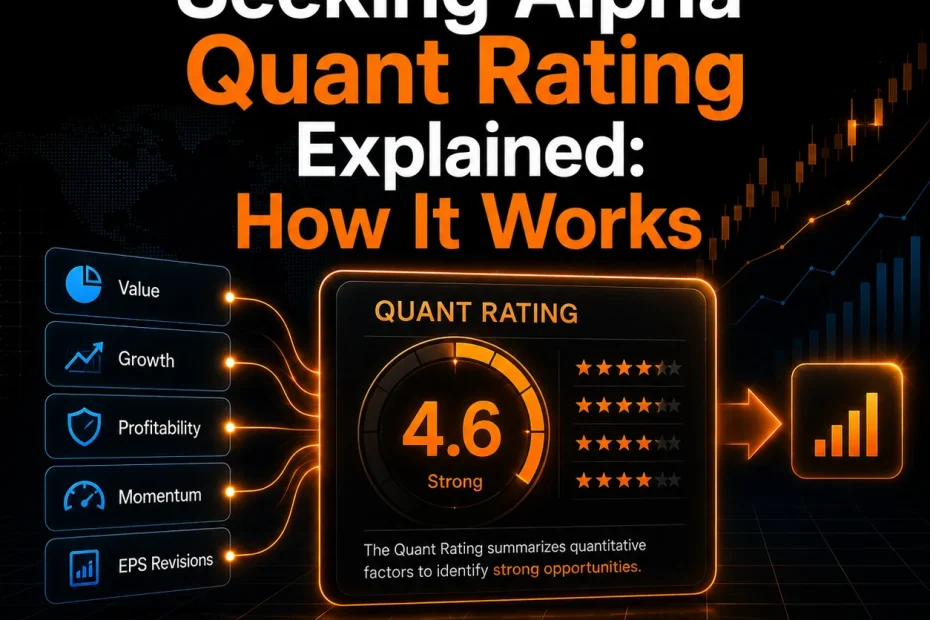
The Seeking Alpha Quant Rating is the platform’s flagship algorithmic stock score. Every covered stock gets a letter grade across five factors and an overall Strong Buy / Buy / Hold / Sell / Strong Sell rating. This guide breaks down exactly how the rating works, what each factor means, and how to actually use it in your decisions. If you’ve ever wondered why Seeking Alpha Premium subscribers swear by Quant, this is the answer.
What Is the Quant Rating?
It’s an algorithmic score, refreshed daily, that ranks every covered stock by combining five fundamental and technical factors. Each factor gets a letter grade (A+ to F) and the overall Quant Rating is the weighted result.
The point of the system: remove analyst bias. The math runs the same regardless of who covers the stock or whether they like the management team.
🎯 Access Quant Ratings on 4,000+ Stocks
Premium unlocks the full Quant Rating system with 5-factor letter grades and historical accuracy data.
The 5 Factors That Drive the Score
1. Valuation
P/E ratios, P/S, PEG, EV/EBITDA — versus the stock’s own history and sector peers. A stock cheap on multiple valuation measures earns an A.
2. Growth
Revenue, EBITDA, earnings, free cash flow growth — both historical and forward-looking estimates. High and accelerating growth = A grade.
3. Profitability
Gross margins, operating margins, return on equity, return on assets. Stable and high-margin businesses score well.
4. Momentum
Recent price performance — 3, 6, 9 and 12-month returns relative to the broader market. Stocks already trending up score higher (momentum is one of the most documented anomalies in finance).
5. EPS Revisions
How sell-side analyst earnings estimates have moved over the last 90 days. Upward revisions = bullish signal; downward = bearish. Historically the single most predictive of the five.
How Strong Buy Is Calculated
To earn a “Strong Buy” Quant Rating, a stock generally needs to score in the top tier across most of the 5 factors — not just one outlier. The exact weighting isn’t public, but typically a Strong Buy looks like:
- Valuation: B or better
- Growth: A or B
- Profitability: A or B
- Momentum: A or B
- EPS Revisions: A or B
Roughly 100-300 stocks hold a Strong Buy at any given time on Seeking Alpha, out of the 4,000+ covered.
How to Actually Use the Quant Rating
- Filter your watchlist: anything that drops from Strong Buy to Hold is a yellow flag to investigate.
- Screen for ideas: filter “Strong Buy” + dividend yield + market cap to find income names.
- Sanity-check buys: before purchasing any name, check its Quant. If it’s a Sell, you need a very good reason to override the data.
- Cross-reference with Author Ratings: when Quant and human analysts agree, the conviction is highest.
Limitations
- Past data only: like all quant systems, it’s backward-looking. A great rating doesn’t guarantee future returns.
- Small caps: coverage of micro and small caps is shallower; ratings can be less stable.
- Style biases: the system favours profitable, established companies — early-stage growth stocks often score poorly even when the thesis is strong.
FAQ
Is the Quant Rating accurate?
Seeking Alpha publishes audited backtests showing Strong Buy-rated stocks outperformed the S&P 500 over multi-year windows. No system is perfect but the track record is strong.
How often does the Quant Rating update?
Daily, based on the latest market data and analyst estimate revisions.
Can I see the Quant Rating without paying?
The basic letter grade is visible on the ticker page even for free users, but the full factor breakdown and history require Premium.
Get the Full Quant + Picks Bundle
Premium + Alpha Picks for $639 — every pick comes with its Quant scorecard.
Affiliate disclosure: We may earn a commission if you subscribe to Seeking Alpha through links on this page, at no cost to you. Opinions are our own, not Seeking Alpha's. Not investment advice.